Full Circle! 😀
This week marks the end of Discovery Park!!
There was not a brand-new feature added this week. This project was never really about making the biggest or most content-heavy level possible.
It was about filling in the missing bricks in Unreal Engine: the systems, workflows, and technical areas I was already familiar with, but had not fully built and understood for myself yet.
Going into this project, Unreal Engine itself was not new to me. What was new was slowing down and making sure I actually understood what was happening underneath the surface.
Not just placing things into a level, but understanding how player input is applied in a blank project, how interaction systems are structured, how gameplay classes communicate, how NPC behavior is organized, how animation and sound sync to movement, and how presentation tools like lighting, cinematics, and VFX are set up to shape player experiences.
Discovery Park: The Final Full List
Over the course of Discovery Park, I successfully built (so much!):
- A custom player character, camera boom, and third-person camera setup
- An Enhanced Input system with movement, look, jump, and interact
- A reusable interaction system using line traces and Blueprint Interfaces
- Interactable world objects like a test cube and lever
- Gameplay architecture using GameMode, GameState, PlayerState, and an Objective Manager
- An event-driven objective HUD with audio and visual feedback
- An NPC with patrol and react-to-player behavior using a Blackboard and Behavior Tree
- Animation blueprints and blend spaces for both the player and NPC
- Synced footstep sounds, ambient environmental audio, and simple NPC dialogue UI
- Intentional lighting and post-process work using Lumen
- A short cinematic intro using Sequencer, CineCameraActor, Take Recorder, and Movie Render Queue
- Niagara particle effects, emissive materials, volumetric fog, and lever-triggered VFX polish.
What I am happiest about is that these were not just isolated features dropped into a scene. They all connected and I gained an understanding of how to build them together.
The player can move through the space using systems I built from a blank project foundation.
They can detect and interact with objects through a reusable interface-based interaction system.
The game can track progression through the correct Unreal gameplay classes instead of stuffing everything into the Player Character.
The NPC can patrol, react, animate, and speak.
The level can guide the eye through lighting, post-process, cinematics, and VFX rather than relying only on text.
Final Reflections
This project ended successfully.
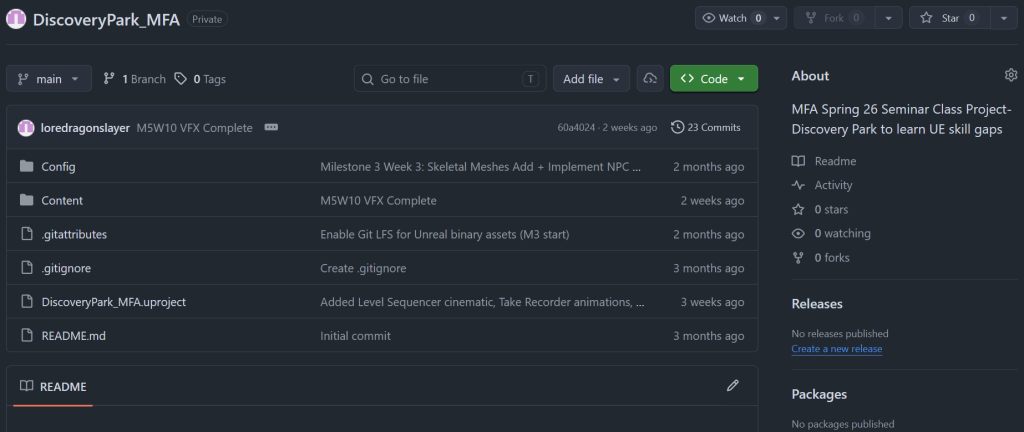
Discovery Park did exactly what I needed it to do. It filled in the missing bricks.
I leave this project feeling more confident in Unreal Engine, more capable of building gameplay systems myself, and more able to move through the engine with deep understanding rather than guesswork.
And that…is a very good place to end. 🙂
What is Next?
This project closes out my first year of the MFA program!
Next year will be a different kind of challenge taking everything I’ve learned at Clark University and applying it toward running my own game studio.
Thank you to all my readers over the last two semesters of this blog who read every post and followed me on my journey of learning.
Until next time,
~Lauren
